


Lithium
Iron Phosphate

Custom LiFePO4
Battery Pack Manufacturer

Lithium Iron Phosphate, often abbreviated as LiFePO4 or LFP, has established itself as one of the battery technologies offering a compromise balance between safety, lifespan, cost, and reliability. For engineers and design firms, LiFePO4 chemistry represents a stable and proven solution. At Enix Power Solutions (EPS), the engineering and design of custom LiFePO4 battery packs follow a rigorous process: designing the exact architecture your industrial application requires, without compromise.

Are you looking for a technical partner to develop your custom battery pack? Our design office can analyse your specifications.

Why Choose
Enix Power Solutions

For this Technology?

Our team of engineers is on hand to analyse your specifications

As pioneers in the integration of LiFePO4 technology, we have been designing and manufacturing battery packs based on this chemistry since 2009. With over 15 years’ experience, we have established a recognised track record in the design, integration and industrialisation of reliable, high-performance and sustainable battery solutions.

Our added value is based on 30 years of global expertise in the integration of batteries, accumulators and control electronics.

Our positioning as a LiFePO4 battery pack manufacturer is based on complete technological neutrality. As a system integrator, our approach involves selecting, for each project, the most suitable components – whether battery formats (cylindrical, prismatic, pouch cells) or battery management electronics – in order to precisely meet our customers’ specific needs and constraints. We carry out a detailed analysis of the charge/discharge behaviour, internal resistance, dispersion and ageing of each cell to ensure the pack’s reliability throughout its entire life cycle.

In what situations should
this technology be used?

LiFePO4 technology is a particularly well-suited solution when intrinsic safety, electrochemical stability, and cycle life are key criteria.

We recommend the use of Lithium Iron Phosphate for equipment in the following sectors:

A Rigorous Approach


We approve the use of LiFePO4 only after a detailed analysis of your specifications. If your specifications change, we will adjust our technical recommendation accordingly.

The Mistake to Avoid

We approve the use of LiFePO4 only after a detailed analysis of your specifications. If your specifications change, we will adjust our technical recommendation accordingly.

Benefits for a custom battery pack

Each technical advantage of Lithium Iron Phosphate 
must be considered in the context of the constraints of your application:

USE CASE

Replacing a lead acid battery with a LiFePO4 solution

Custom lifepo4 battery packs for industrial applications

Client context 

Our client was operating an industrial application powered by lead-acid batteries. As part of an initiative to improve performance and reduce maintenance requirements, they wished to migrate to lithium technology.

Technical constraints of the project

  • Significantly reduced footprint: the space available for the new battery was only 50 per cent of that of the existing lead-acid pack.
  • Trickle-charging mode.
  • Precise monitoring of the battery’s state of charge (SOC) and state of health (SOH).
  • Integration of CAN bus communication.
Custom lifepo4 battery packs for industrial applications
Case study for a custom LiFePO4 battery pack created by EPS

As specialists dedicated to the design of custom LiFePO4 battery packs,
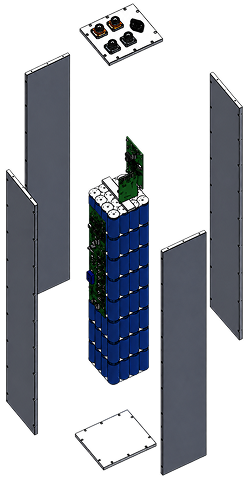
we carried out the design, sizing and manufacture of a complete unit incorporating:

Electrical architecture
Rated voltage of 25.2 V (8S16P) with a capacity of 44.8 Ah.
Cells used
26650 Cylindrical format (3.2 V / 2.8 Ah).
Integrated electronics
A 140 A BMS specifically designed for LiFePO4 chemistry. This system manages the pack’s safety, calculates SOC/SOH, handles the CAN communication interface, and puts the battery into sleep mode and reactivates it in the event of inactivity.

The choice of LiFePO4 offered a much safer integration than NMC lithium chemistry for this industrial application. The battery pack offers a significant reduction in size whilst increasing service life and flexibility of use (trickle charging validated). The final system is fully compliant with regulatory and standards requirements: UN38.3, IEC62619, CE marking and functional safety.

Planning a migration or a battery retrofit?

BMS for custom battery packs

BMS, PCM & associated

protection circuits

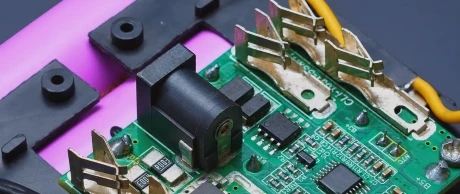
Lithium iron phosphate technology requires specific management electronics and protective circuits.

The primary role of the BMS (Battery Management System) or PCM is to protect the end user and ensure the safe operation…

of the system. Our battery pack designs incorporate these management circuits to ensure cell balancing, safety cut-off functions, monitoring of State of Charge (SOC) and State of Health (SOH), as well as the communication interface with your equipment.

Custom battery certification un38.3

Transport, certifications

& regulations

The placing on the market of equipment incorporating an LFP battery requires strict compliance with current regulations.
Every battery pack project includes preparation for the certifications required for European and international…

 marketing:

  • UN38.3: Standards for the safe transport of lithium.
  • IEC standards: Validation of electrical safety (in particular IEC 62133 or IEC 62619).
  • UL2054: Specific certification required according to your needs for access to the US market.

All our designs incorporate the regulatory requirements relating to battery packs. To find out more about the latest directives and legal obligations, please visit our page dedicated to European battery regulations.

Factors to consider
before choosing this technology

In order to validate the choice of Lithium Iron Phosphate and commence the technical study, several parameters in your specifications must be precisely defined:

Voltage & Capacity

To ensure the associated device operates correctly

Current peaks (duration, frequency)

Providing a discharge curve is a bonus

Communication Protocol

(SM Bus, I2C, CAN or other) and the expected data (State of Charge – SOC, State of Health – SOH)

Dimensions & Integration

Available dimensions, geometry and casing type (custom casing or heat-shrink sleeve)

Connector

Specific connector type and cable length

Environment & Temperature

Operating temperature range

Timeframe

Quantities and timeframe for the first prototype, first production run and estimated annual volume

Economic objective

Target unit price for mass production

Custom LiFePO4 Battery Pack Manufacturer

Are you in search of a Custom LiFePO4 Battery Pack Manufacturer?

Enix Power Solutions can provide you with comprehensive support in defining the architecture, integrating the BMS and manufacturing your custom battery solution.

FAQ

LiFePO4 is recommended for industrial projects (robotics, medical applications, instrumentation) where electrochemical stability, safety and cost control take precedence over absolute compactness.

Like all lithium batteries, LiFePO4 battery packs must be certified as compliant with UN38.3 regulations in order to be transported legally and safely.

LiFePO4 is recommended for industrial projects (robotics, medical applications, instrumentation) where electrochemical stability, safety and cost control take precedence over absolute compactness.

Like all lithium batteries, LiFePO4 battery packs must be certified as compliant with UN38.3 regulations in order to be transported legally and safely.

OUR PARTNERS