
BMS & PCM
Battery Management Systems & Protection Circuit Modules
INTEGRATION OF BMS AND PCM
INTO YOUR CUSTOM BATTERY PACKS
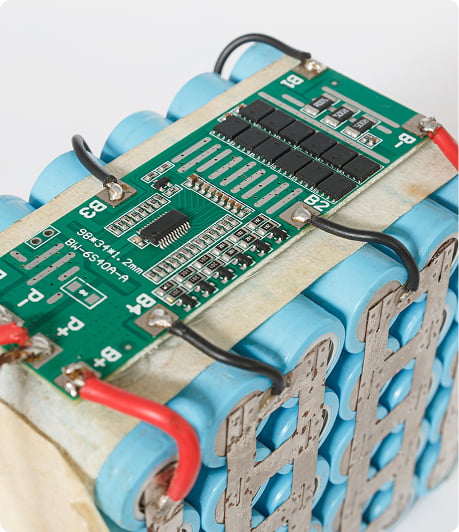
At Enix Power Solutions, we integrate Battery Management Systems (BMS) and Protection Control Modules (PCM) into the custom battery packs we design and manufacture for our OEM clients.
We act as expert integrators: we select, configure and integrate the electronic management solution best suited to your application, environmental constraints and reliability requirements.
Whether you are developing a medical device, an instrumentation system, robotic equipment or an alarm and monitoring solution, our team of engineers will design a BMS or PCM that will ensure the safety, longevity and performance of your battery.
Battery Management System (BMS)
The BMS (Battery Management System) is an electronic system integrated into the battery pack that provides protection functions and, where required, advanced management, measurement, balancing and communication functions. Its functional level depends directly on the battery architecture and the project requirements. We integrate active or passive BMS systems depending on the technical and economic objectives of the battery pack.
Features commonly included in our BMS:
Monitoring and communication:
- SOC (state of charge) / SOH (state of health) / DOD (depth of discharge)
- Total energy since initial commissioning
- External communication protocols (CAN bus, SMBus, etc.)
Protections:
- Maximum end-of-charge voltage / End-of-discharge cut-off
- Overcurrent and overheating protection
Active BMS (non-dissipative)
The active BMS redistributes energy between cells to reduce discrepancies in state of charge without significant heat dissipation. This architecture may be selected when the project aims for more advanced management of available energy, optimised sizing or improved long-term performance.
The benefits sought include:
|
|
Passive BMS (dissipative)
Passive BMS corrects cell imbalances through heat dissipation, usually via resistors. This solution is often chosen when there is a genuine need for balancing, but the economic and operational context does not justify a more complex architecture.
Protection circuit module
(PCM)
The PCM (Protection Circuit Module) is an electronic board integrated into rechargeable lithium battery packs to provide basic protection. It differs from the BMS in that it has a more limited scope of functionality, restricted to essential protection features, without advanced functions such as balancing, communication or state monitoring (SOC/SOH).
The use of a PCM is appropriate when the primary requirement is the electrical protection of the pack, with no need for advanced control or data feedback to the system. The choice between a PCM and a BMS must always be based on the specifications of the battery, the equipment and the operating environment.
Integrated protection functions:
- Maximum end-of-charge voltage
- End-of-discharge cut-off
- Overcurrent
- Overheating
OUR AREAS OF EXPERTISE
BMS & PCM








Why choose Enix Power SOlutions?
-
30 years’ experience in designing custom industrial battery packs
This experience enables us to approach every project with a focus on feasibility, reliability and industrialisation. -
A design office approach focused on specifications
Our engineers analyse the project’s requirements to determine the most appropriate battery architecture and associated electronics. This analysis enables us to make informed decisions: whether to develop a bespoke PCM or BMS, adapt an existing solution from our catalogue, or integrate a standard BMS. -
An integrated approach, not just a simple supply
Each electronic component, whether the BMS or the PCM, is selected in accordance with the battery pack’s specifications: voltage, current, safety requirements, communication protocols, dimensions, interfaces and integration constraints. -
Support with quality and compliance requirements
Documentation, regulatory and market requirements are taken into account right from the design stage. Our approach is based on a structured working environment and standards tailored to the specific applications, including IEC, UL, etc. Depending on the project, sector-specific and regulatory requirements are incorporated from the design phase of the battery pack and its associated electronics.
OUR PARTNERS